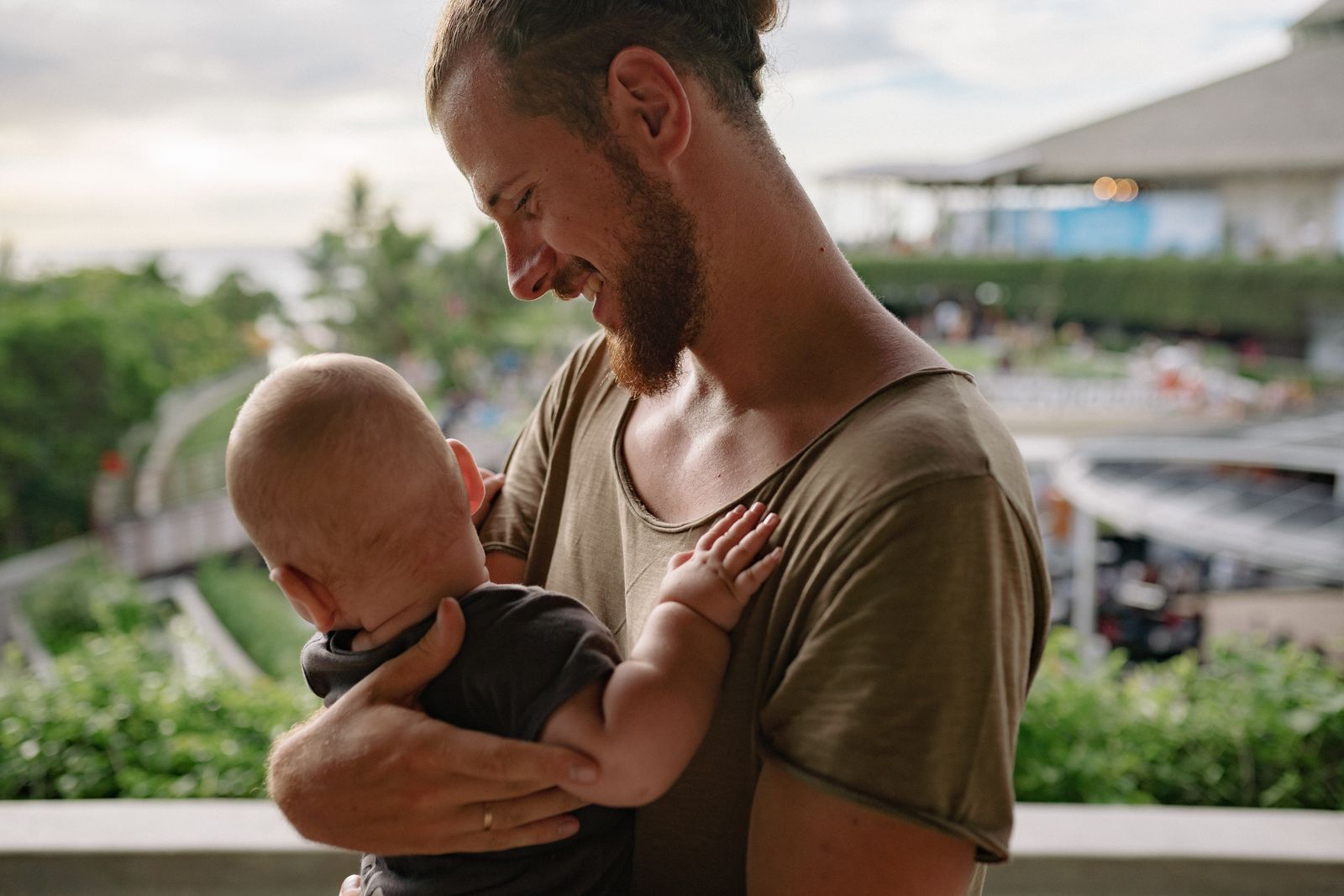
Two families can take the same parental leave in Sweden and be paid very different amounts for it. In 2026, a full day of parental benefit at the sickness benefit level pays anywhere between SEK 250 and SEK 1,259. A household that has just moved here can land at the bottom of that range whatever the salary, because the higher amounts require 240 days of qualifying income before the birth. Checking how long you have been insured in Sweden is the first thing worth doing.
Parental leave in Sweden has two parts that are easy to confuse. Föräldraledighet is your legal right to be off work to care for your child. Föräldrapenning, or parental benefit, is the money paid by the Swedish Social Insurance Agency (Försäkringskassan) while you are on that leave. You can take leave without taking the benefit, and you do not have to use all your benefit days at once.
Swedish parental benefit depends on where you live and work
Before the days and the amounts come into play, Försäkringskassan decides whether you are insured in Sweden at all, and the answer can differ from one benefit to another. The benefits are split into two lists, and a newly arrived family can easily qualify for one list and not the other.
To be entitled to child allowance and to parental benefit at the minimum level and the basic level, you must live in Sweden. To be entitled to parental benefit at the sickness benefit level and the basic level, you must work or have worked in Sweden. The work requirement also covers pregnancy benefit and vab, the compensation for care of a sick child. Citizenship does not enter into it. Where you live and where you work decide it, and it is not possible to be covered by two countries’ social insurance at the same time.
A parent who has moved here with a partner but has not yet started working can still be entitled to days, but the income-based part of the benefit rests on work. If one of you works in another country, Försäkringskassan sometimes needs information from that country’s authority in order to decide whether you should be insured in Sweden.
How much parental benefit pays per day in 2026
In 2026, a full day at the sickness benefit level pays between SEK 250 and SEK 1,259, and a full day at the minimum level pays SEK 180. Most people with a regular income receive parental benefit calculated from their sickness benefit qualifying income, known by its Swedish abbreviation SGI, and the benefit usually works out at around 80 percent of salary.
To receive it you need to have been entitled to an SGI corresponding to a monthly salary of at least SEK 7,083 for at least 240 days before the child’s expected date of birth. Below that, the benefit can be lower. The SEK 7,083 threshold is a 2026 figure. This threshold is set out on Försäkringskassan’s Swedish-language page on parental benefit, which also carries the daily amounts. The English-language pages state the minimum level of SEK 180 but do not mention the 240-day requirement, so an English-speaking parent can read the whole English section and never meet the rule that decides the benefit level.
You can still receive parental benefit with no income and no SGI. In that case you receive the lowest amount at the sickness benefit level rather than nothing, which is why the range starts at SEK 250 rather than at zero. All the amounts above are 2026 figures and are recalculated at the turn of the year. Försäkringskassan deducts preliminary tax before each payment, so the sum that reaches your account is lower than the daily figure suggests.
How the 480 days are divided
Parents share a total of 480 days of parental benefit per child, roughly 16 months. Of those, 390 days are paid at the sickness benefit level and the remaining 90 at the minimum level. Where there are two parents, the days are split equally: 195 days each at the sickness benefit level and 45 days each at the minimum level, 240 days each in total. Of each parent’s share, 90 days at the sickness benefit level are reserved and cannot be transferred to the other parent. A parent with sole custody is entitled to all 480 days.
The first 180 days taken out for the child must be days at the sickness benefit level, counted jointly for both parents. Only once those 180 days are used can either of you start drawing minimum-level days. Twins bring the total to 660 days, triplets to 840.
During the child’s first 15 months, both parents can draw benefit for the same day, up to a maximum of 60 such double days. Each double day deducts two days from the shared pot, one from each parent, so using all 60 costs 120 days. Reserved days are not affected.
How long you can use your parental benefit days
You can draw parental benefit up to and including the day the child turns 12, or until the child finishes Year 5 at compulsory school. From the child’s fourth birthday, though, you can only save 96 days in total, or 132 days for twins. Days beyond those 96 cannot be used after the fourth birthday.
The days can be taken as whole or part days.
You can transfer up to 45 days to a grandparent
You can transfer up to 45 days of your parental benefit to another carer, for example the child’s grandparent, and up to 90 days if you have sole custody. The person caring for the child has to apply in their own name once the days have been transferred. For families with grandparents abroad who visit for long stretches, this gives extra cover.
Going part time can lower your sickness benefit and vab
Cutting your hours once the leave ends reduces the salary your SGI is calculated from, and you will then receive less compensation if you get sick or stay home to care for a sick child. Your parental benefit is protected during the first two years of the child’s life. If you take parental leave again before the child turns two, you receive the same amount of parental benefit as before. The same applies if you or your partner become pregnant with another child before the older child is one year and nine months old. While the child is under one, being on parental leave full time or part time protects the qualifying income by itself. After the child’s first birthday, if you are on parental leave full time, you keep your previous qualifying income by taking at least five whole parental benefit days per week. If you begin working full time or part time, your qualifying income is recalculated on the salary you then receive. If you have reduced your hours and want to protect the previous figure, you can take parental benefit for a time equal to the reduction in working hours.
Beyond those rules, you decide how to spread the leave. One way to plan is for one parent to be home for the first stretch and the other to take over later, sometimes overlapping for a short period, with the child staying home until around the age of one and then starting förskola (preschool). Keeping a reserve of days covers holidays, illness and the gradual settling-in period at the start of förskola.
Vab, child allowance and the 10 days at the birth are extra
- Temporary parental benefit (vab) covers staying home when your child is ill, for a maximum of 120 days per year. For the final 60 of those days, compensation is paid only when the child is ill, not when the child’s regular carer is. Vab is calculated separately from parental benefit.
- Child allowance (barnbidrag) is a monthly payment for every child, with a supplement for larger families. You do not apply for it, but the automatic payment is conditional: Försäkringskassan pays it if you are the legal custodian of a child under 16 who lives in Sweden, and both you and the child are insured in Sweden. If you have just moved here, that insurance status is the part to check.
- The 10 days around the birth are separate from the 480 shared days. They have to be taken within 60 days of coming home from the delivery, and the application has to reach Försäkringskassan no more than 30 days after the first day you were home with the child.
- Pregnancy benefit is also separate, and it sits on the work side of the insurance split rather than the residence side.
- If a parent lives, works or draws a pension in another EU or EEA country or Switzerland, the countries coordinate who pays, and you cannot choose which country pays your family benefits. The second country may top up the difference if its benefits are higher.
Apply within 90 days of your first parental benefit day
You apply online through Mina sidor by logging in with a Swedish electronic identification such as BankID. The deadline is firm: the application has to be in no later than 90 days after the first parental benefit day you have taken. Applying for as long a period as possible keeps the payments regular. Any change, such as going back to work earlier than planned, needs a fresh application rather than an edit to the old one.
Försäkringskassan’s e-services are only available in Swedish, although you can get assistance by booking a meeting, in person or online, by calling the call centre, or at a service office. Parental benefit cannot be drawn during paid holiday, so holiday days have to be left out of the application.
Check your insurance status and your SGI first, then map out the days. Do both in the first weeks after a move.
Last fact-checked: 23 September 2026