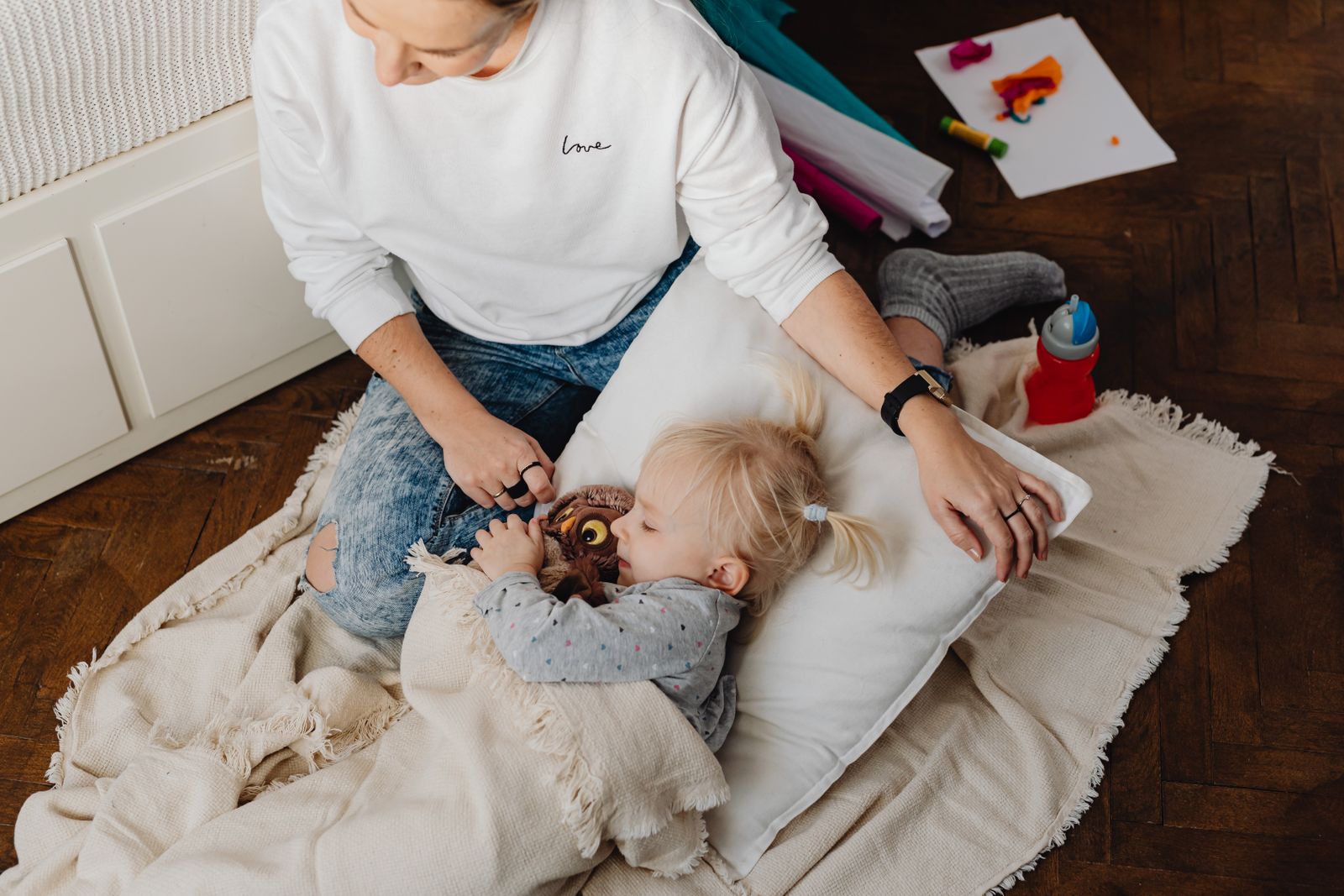
Your toddler wakes up too warm to go anywhere, förskola is out, and one of you has to stay home. In Sweden that day has a name, vab, and Försäkringskassan pays for it. You stay home first and apply afterwards, and the money lands at a little under 80 percent of your income, up to a ceiling. Here is how to claim it, what it pays, and which days do not count.
Vab is short for vård av barn, care of a child. The benefit’s formal name is tillfällig föräldrapenning, temporary parental benefit, but nobody says that. Swedes made the abbreviation into a verb, att vabba, and you will hear colleagues use it without a second thought. There is no clean English translation because there is no English equivalent: it is not your own sick leave, and it does not come out of your shared parental leave days. It is a separate benefit, with its own allowance of days for each child, every year.
Who can claim vab, and for which children
You can claim from the day your child turns eight months old up to the day before the twelfth birthday, according to Försäkringskassan’s English page on vab. For a baby under eight months the rules are narrower: it works if the child is in hospital, or if the child already has a place in childcare and is too ill to go. Older children have their own rules, and so do children with a serious illness or a disability.
Three other conditions have to hold at the same time. You give up work, or give up unemployment benefit if you are looking for work. Your child lives in Sweden, in another EU or EEA country, in Switzerland or in the United Kingdom. And you are insured in Sweden, which most people who live or work here are.
Staying home with a feverish child is the obvious case, but Försäkringskassan’s Swedish page lists several others: taking your child to BVC, the dentist, a doctor or child and adolescent psychiatry; being home because the person who normally looks after your child is ill; going to a meeting at preschool or school about your child’s illness or disability; and teaching staff there how to handle a care need such as diabetes.
You do not have to take the whole day. A day can be split into 75, 50, 25 or 12.5 percent, so two parents can share one day between them or take turns from one illness to the next.
Grandparents and neighbours can vab too
You do not have to be the child’s parent. Someone who lives with a parent, a foster parent, a specially appointed guardian or a prospective adoptive parent is treated as a parent for this purpose. Beyond that circle, a grandparent or a neighbour can also be paid for vab in specific situations, set out by Försäkringskassan: when the parent could have cared for the child but chooses to work and hands the right over, when the parent is ill and consents, or when a child under three has a single parent who is ill and lives with nobody else who could step in. The person vabbing has to meet the ordinary conditions too: giving up paid work, and having an income that counts.
The first claim for a child starts with a phone call
Whichever group you are in, the first time you claim for a particular child you have to ring Försäkringskassan on 0771-524 524 so they can connect you to the child in their system. What happens after that depends on the group. If you count as a parent, you apply in the ordinary e-service afterwards. If you are outside that circle, an application form arrives by post instead, and from then on you order a new one yourself.
How many days you get
Each child comes with 120 days a year. If several people care for the child, you share those days rather than getting 120 each. Once 60 of the 120 have gone, one reason for claiming drops away: you can no longer be paid because the person who normally looks after your child is ill. You can still claim when the child is ill, needs to see a doctor and so on.
Mina sidor has a vab calendar you can share with the other parent. It shows who has used which days, whose turn it is next, and everything you have applied for this year and last. Set it up before you need it, because it also stops the two of you applying for the same hours.
What vab pays
Vab is built on your SGI, or sjukpenninggrundande inkomst, which for most employees is simply their annual salary. The rules for temporary parental benefit point to the same calculation used for sickness benefit: your SGI is first multiplied by 0.97, and 80 percent of the result is what you are paid. That works out at 77.6 percent of your SGI, which is where the wording on Försäkringskassan’s Swedish vab page, “a little less than 80 percent of your normal income”, comes from.
Vab uses a lower ceiling than the benefits it sits next to. Income above 7.5 prisbasbelopp is left out of the vab calculation, which puts the ceiling at 444,000 kronor in 2026. Sickness benefit and income-based parental benefit use ten prisbasbelopp instead, so on a high salary a vab day pays proportionally less than a sick day of your own. The government resets the prisbasbelopp every year, and Försäkringskassan publishes the current figures.
There is a floor as well, and it matters if you have just arrived and are working occasional shifts. You need earned income of at least 14,200 kronor a year, plus regular work, to have an SGI at all. Below that there is no SGI, and without an SGI there is no vab payment. Benefits, including student finance from CSN, do not build an SGI.
One thing to watch if you look the figures up in English: Försäkringskassan’s English page about SGI still gives the ceiling for care of a child in 2025 figures, as 441,000 kronor. The numbers here are the 2026 ones.
| What | Where it lands in 2026 |
|---|---|
| Child’s age | From eight months to the day before the twelfth birthday |
| Days per child, per year | 120, shared by everyone who cares for the child |
| Compensation | A little under 80 percent of your SGI |
| Income ceiling | 7.5 prisbasbelopp, so 444,000 kronor |
| Certificate | Needed from the eighth day of the illness |
| Deadline to apply | Within 30 days of your first day at home, later only in exceptional cases |
| Payment | In arrears, on the 25th of the month |
Certificates and deadlines
Short illnesses need nothing beyond your application. If your child is ill for more than a week you need a certificate from a doctor or a nurse. Försäkringskassan’s English page counts that week “beginning with the 8th day of illness”, and days you do not claim for count towards it too, weekends included, so a Wednesday to Wednesday stretch reaches the limit even if you only claimed five days.
Nothing is paid for days that fall more than 30 days before your application arrives. If you are home for several weeks, send in an application along the way rather than waiting until your child is well and you are back at work. An application that arrives later than that is only paid in exceptional cases, such as if you were too ill or too badly injured to apply in time.
None of this is medical advice, and Försäkringskassan does not give any. If you are unsure whether a fever needs looking at, 1177 has guidance on fever in children in English, and our guide to English-speaking healthcare for your toddler covers how to get seen.
The days that do not count
Some of the situations that feel like they should qualify do not. Försäkringskassan lists five of them on its Swedish vab page. You cannot claim vab if you are working. You cannot claim during inskolning, the settling-in period when your child starts förskola. You cannot claim when the other parent is on parental leave with another child, with some exceptions. And you cannot claim when a sibling is being born and you both go to the delivery.
The fifth is the closed preschool. If your child is perfectly well and förskola shuts for the day, that is a matter for you and your employer, not for Försäkringskassan.
The same goes for working from the sofa while your child naps. Whatever your colleagues call it, Försäkringskassan does not pay vab for hours you work. And if you have reported yourself sick to your employer, you cannot draw vab for the same days.
Your employer reports your vab days too
A law on reporting absence for care of a child has changed what your workplace tells the state about your days at home. Everyone who files an employer PAYE return has to state whether the pay they report was affected by absence that could give a right to parental benefit or temporary parental benefit. Where it was, they also have to give the dates and the extent of that absence. Skatteverket passes the information on to Försäkringskassan, and your employer has to tell you what it has reported about you by the day the return is due. The purpose, stated plainly in the law’s opening section, is to make Försäkringskassan’s checks on parental benefits more efficient. The rules came into force on 1 January 2025 and applied first to returns for the January 2025 reporting period.
This is easy to live with once you know about it. The days you claim from Försäkringskassan and the days your workplace records as absence meet in one place, so report the same dates to both, and correct one if you correct the other.
Frequently asked questions
My child fell ill while we were on holiday. Can I switch to vab?
Yes, but the order matters. Contact your employer and interrupt your holiday first, then apply. It works if you are in Sweden, another EU or EEA country, or Switzerland. If you are travelling further afield, your child has to have been ill before the trip, and you need Försäkringskassan’s consent before you leave, which you apply for at least a week ahead.
I am on parental leave with the baby and my toddler is ill. Can I claim vab instead?
Only if the child is admitted to hospital. In that case both parents can be paid vab for the same child over the same period.
I am studying. Does vab apply to me?
If you receive student finance, report the vab to CSN rather than claiming it from Försäkringskassan. If you work alongside your studies you can be paid for the hours you would have worked, as long as you have an SGI. If you have neither student finance nor a job, there is no vab.
I made a mistake in my application. What now?
An application cannot be edited once it is signed and sent. If the money has not arrived yet, ring 0771-524 524, say it concerns vab, and wait for the correction rather than sending a second application. If you have already been paid too much, report it on Mina sidor.
Getting ready before the first sick day
Vab is claimed after the fact, so the preparation that helps is paperwork, and it can be done on a calm evening. Two things set you up.
First, check what Mina sidor already holds about you. Försäkringskassan’s English checklist for vab asks you to look over the pre-filled fields: salary, employer, and the preschool or school your child attends. The school’s telephone number is on that list because Försäkringskassan uses it to verify days of absence.
Second, be ready for the language. The e-services are available in Swedish only, according to Försäkringskassan’s own checklist, which points to the ways round it: book a meeting in person or online, ring the call centre, reach them on social media, or go to one of the service centres around the country. Have your annual salary figure to hand before you start, since the payment is worked out from it.
After that, the routine is short. Stay home, apply within 30 days, share the vab calendar with whoever else looks after your child, and watch for the payment on the 25th. That is the whole of it, and it is one of the easier parts of Swedish family life to get right.
Last fact-checked: 16 August 2026